Zscaler M&A Systems Playbook
Problem
Zscaler’s acquisition strategy included two ARR-bearing companies representing more than $125 million in combined ARR at acquisition, plus a third acquisition centered primarily on personnel and capabilities.
The first Post-Sales systems integration had no established playbook. Teams lacked a repeatable process for evaluating acquired technology, aligning business processes, migrating data, deciding which systems to preserve, or maintaining operational continuity through cutover.
Integration work began before the target operating model had been sufficiently defined. Applications were treated too uniformly, technical and process dependencies surfaced late, and progress stalled for approximately three months. The organization needed more than a recovery plan for one acquisition. It needed a repeatable Post-Sales integration capability that could support future acquisitions without restarting from zero.
Context
Every system introduced a set of interdependent questions. Should it be retained, replaced, temporarily integrated, or retired? Which historical data was valuable enough to migrate? Where should processes be standardized, and where should the acquired team’s operating model be preserved? Could systems coexist through a phased transition, or did they require one coordinated migration?
Those decisions had to be made without disrupting customers, support operations, employee workflows, or the acquired companies’ ability to continue operating.
My Role
Strategy & Process
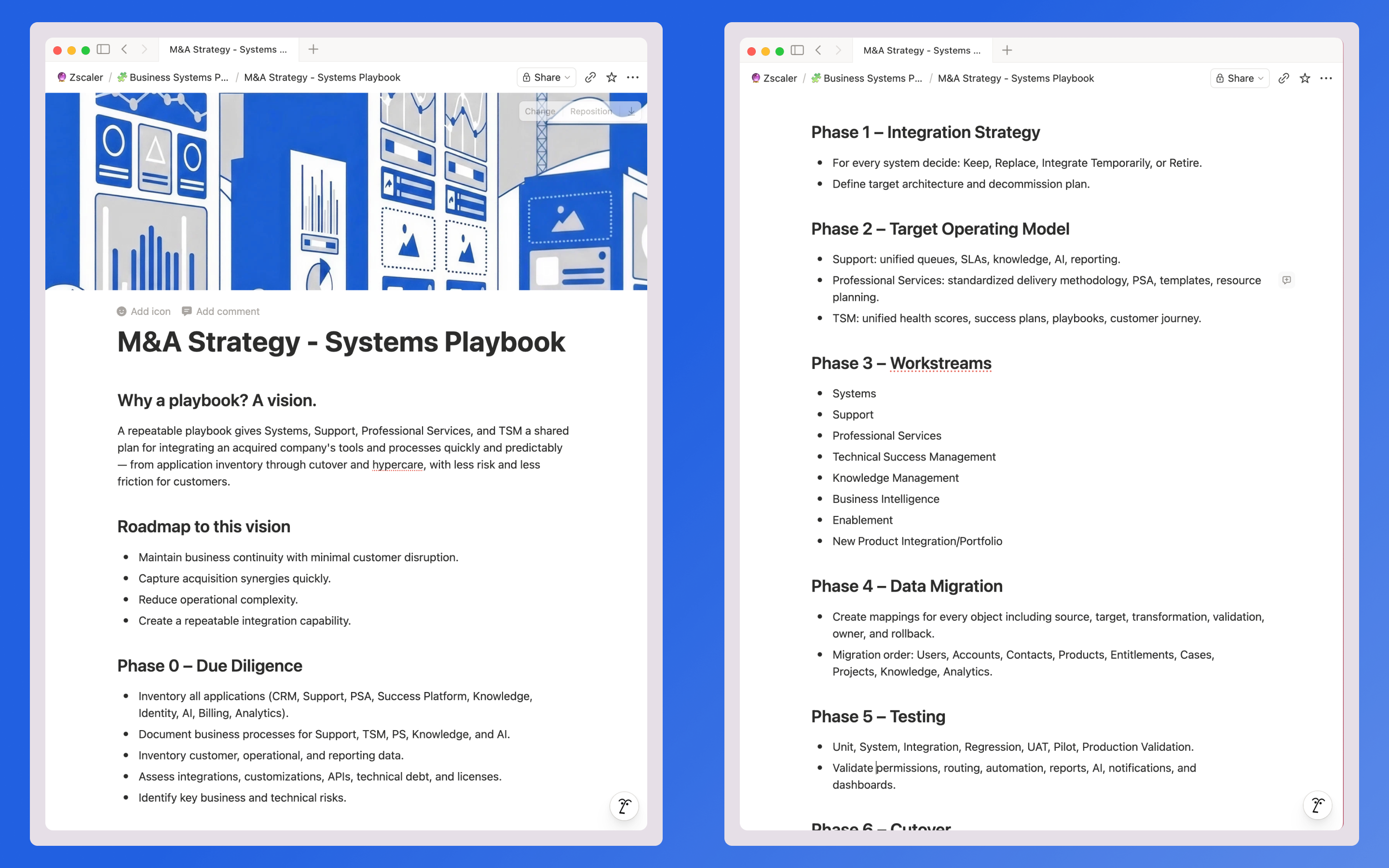
- 1Start With Due DiligenceInventoried applications, processes, data dependencies, and technical debt across Support, Professional Services, Technical Success, Knowledge, and AI before beginning migration work.
- 2Define the Target Operating Model FirstAligned the required Post-Sales processes and ownership model before making system decisions, correcting the sequencing failure that had stalled the first acquisition.
- 3Create a System Decision FrameworkEvaluated every application through a consistent Keep, Replace, Integrate, or Retire framework rather than renegotiating the decision criteria for each system and acquisition.
- 3Map and Sequence the MigrationDefined the source, destination, transformation, validation, owner, rollback requirements, and dependency sequence for users, identity, accounts, cases, knowledge, analytics, AI, and other critical data.
- 3Validate and Stabilize the IntegrationRan a complete test cycle from unit and integration testing through UAT and production validation, then followed each phased cutover with a standard two-week hypercare period.
- 3Use Phased CutoversMigrated systems and processes in controlled stages where temporary coexistence reduced risk, rather than forcing every platform through a single cutover model.
- 4Turn the Recovery Into a PlaybookCaptured the decision frameworks, migration requirements, testing model, cutover sequence, governance, and stabilization practices so the next acquisition could begin with an established integration capability.
Key Decisions
- 1Migrate Data SelectivelyEvaluated historical data based on operational value, regulatory need, migration risk, and cost instead of automatically moving every available record.
- 2Standardize Where It MatteredRequired common processes for capabilities such as CRM and customer support while preserving acquired-team workflows where standardization offered little strategic or operational benefit.
- 2Allow Temporary CoexistenceRan systems in parallel when a short period of coexistence reduced customer, employee, or data-migration risk.
- 3Protect Continuity Over SpeedPrioritized data integrity, SLA compliance, and uninterrupted customer-facing services over pursuing the fastest possible technical consolidation.
Impact
- 1Integration Time Fell From Six Months to One QuarterEntered the first acquisition after approximately three months of stalled progress and drove the Post-Sales workstream to primary cutover over the following six months. The resulting playbook reduced primary-cutover time for the second and third acquisitions to approximately three months each.
- 2Business Continuity Was PreservedMaintained zero downtime across customer-facing services, Salesforce and support operations, acquired-company systems, and other critical business systems through all three primary cutovers. Customer-support and internal operational SLAs remained compliant, as measured by the Enterprise M&A team.
- 2More Than $125 Million in Acquired ARR Was ProtectedPreserved business continuity across the two ARR-bearing acquisitions representing more than $125 million in combined ARR at acquisition. The result reflects protection of the acquired revenue base through continuity and SLA compliance rather than a separately measured retention improvement.
- 2A Repeatable Integration Capability Was EstablishedConverted a one-off recovery into a standing Post-Sales integration playbook covering due diligence, system decisions, process alignment, migration, testing, cutover, and stabilization, then entered a fourth acquisition with the model already in place.
Lessons Learned
Business continuity and data integrity are the primary risks every other integration decision serves. Speed improved because the playbook reduced ambiguity and rework, not because the later acquisitions accepted more operational risk. The goal was not merely to integrate faster. It was to make faster integration repeatable without disrupting customers or the acquired businesses.