Agent Z
Beating Salesforce Agentforce to deflect 37% of support volume, 3.7x the target
Problem
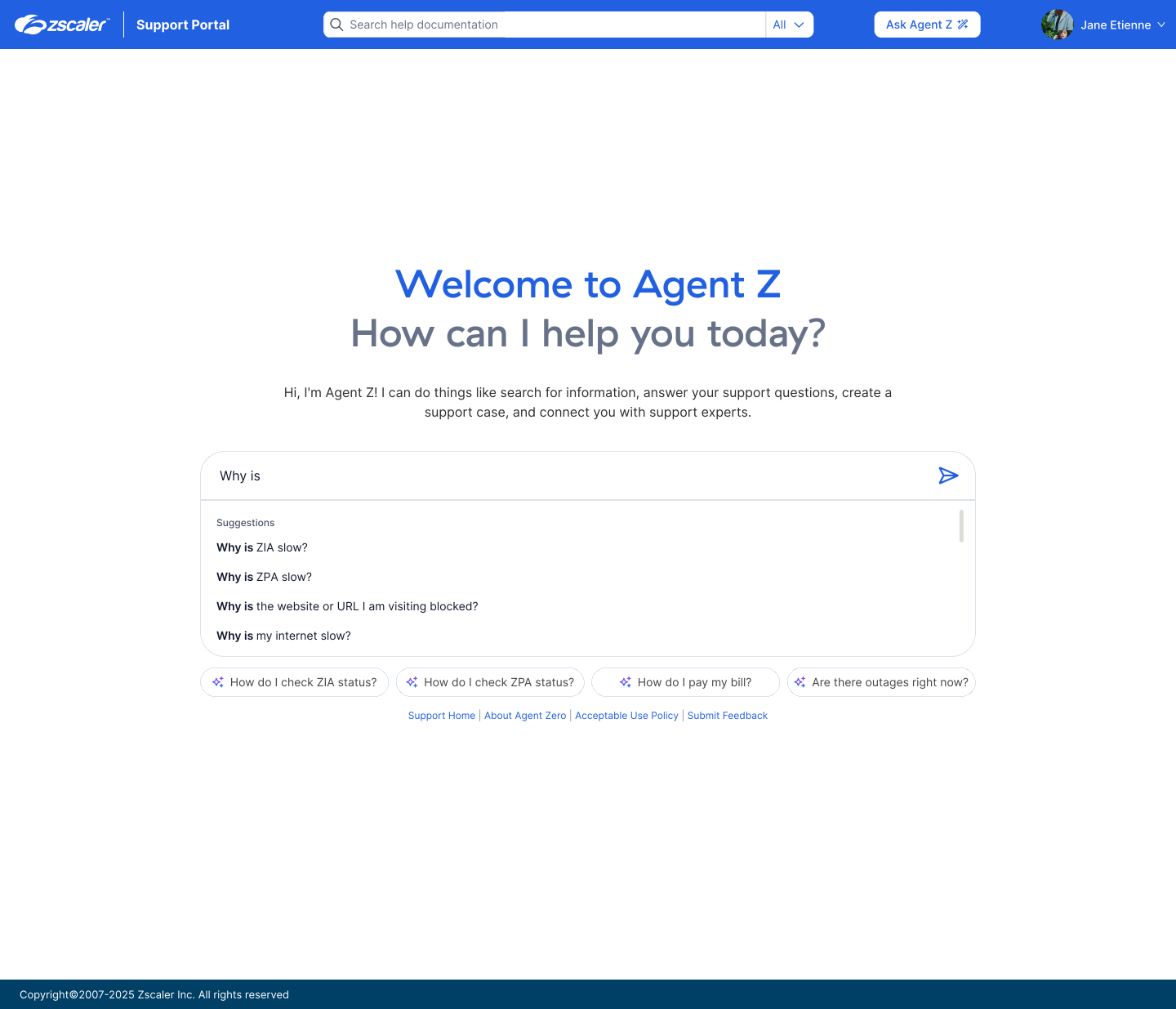
Zscaler's support front door was fragmented: customers could search documentation, email, call, use multiple portal logins, or submit a case through an unauthenticated public form open to anyone.
Support received roughly 325,000 tickets annually across more than 10,000 customers, 35% of it through the unauthenticated form alone, and demand was outpacing capacity.
Executive leadership wanted 10% AI deflection, but you cannot deflect demand you cannot authenticate, understand, or route.
Context
Agent Z began as a strategy for redesigning support entry, not bolting a chatbot onto the existing portal: one intelligent front door that could answer questions, guide customers to resolution, and reduce avoidable demand before it reached Support.
Zscaler had no AI deflection capability at this scale, across 10,000+ customers, thousands of technical documents, and a wide range of product configurations, so accuracy mattered as much as coverage.
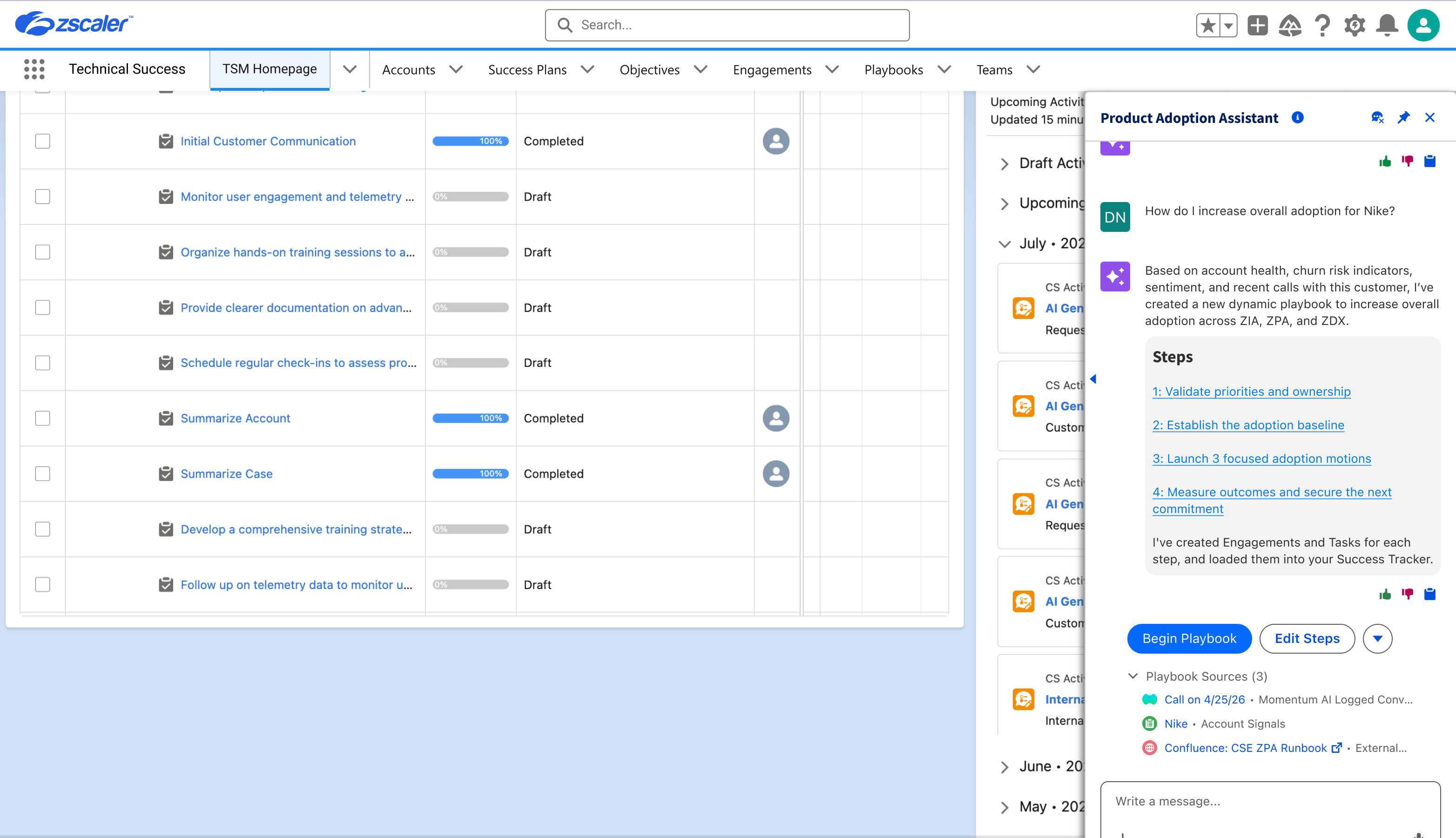
The strategy grew into a multi-agent stack: Agent Z as the customer-facing front door, ResolvR closing knowledge gaps by auto-generating new documentation, and Teammate helping support engineers resolve the complex cases that still reached them.
Zscaler had no AI deflection capability at this scale, across 10,000+ customers, thousands of technical documents, and a wide range of product configurations, so accuracy mattered as much as coverage.
The strategy grew into a multi-agent stack: Agent Z as the customer-facing front door, ResolvR closing knowledge gaps by auto-generating new documentation, and Teammate helping support engineers resolve the complex cases that still reached them.
My Role
As Director of Business Systems Product Management, I owned the end-to-end product vision and strategy for Agent Z: front-door redesign, the build-versus-buy decision, knowledge strategy, staged launch, and the go-to-market call that made it the primary path to case creation.
Strategy & Process
- 1Fix the Front Door FirstConsolidated multiple entry experiences into one authenticated path and deprecated the public form, cutting low-quality demand before AI deflection began.
- 2Prove Build Versus BuyRan a competitive bake-off between Salesforce Agentforce and an internal Agent Z prototype against cost, content ingestion, accuracy, and scalability.
- 3Treat Knowledge as Product InfrastructureAudited roughly 6,000 help documents, removing duplicates and conflicting answers to produce a curated corpus of about 5,000 authoritative documents.
- 3Launch in Controlled StagesMoved from a five-customer beta to a 100-customer limited release to full availability across 10,000+ customers, testing a different risk at each stage.
- 3Build a Continuous Feedback LoopCreated ResolvR to turn unanswered questions into new knowledge content, so coverage improved instead of repeatedly failing on the same gaps.
Key Decisions
- 1Build Instead of BuyChose the internal Agent Z after it outperformed Agentforce in the bake-off on cost and content-ingestion fit at Zscaler's scale.
- 1Redesign Before DeflectingFixed authentication, entry, and routing before measuring deflection, rather than layering AI on a broken journey.
- 1Prioritize Accuracy Over SpeedAccepted a slower first phase to raise task success above the 90% launch threshold; unreliable technical guidance would have cost more in trust than it saved in time.
- 1Separate Pilot Signal From Scaled ResultTreated 70% limited-availability deflection as a small-cohort signal, not the expected result, and used the lower general-availability rate to expose real coverage gaps.
- 1Design a Multi-Agent StackPositioned Agent Z, ResolvR, and Teammate as connected products across customer deflection, knowledge creation, and engineer-assisted resolution.
Impact
- 1Front-Door Demand ReducedCut annual ticket volume 26%, from roughly 325,000 to 240,000, by closing the public form and consolidating entry paths.
- 2Deflection Beat the TargetDelivered 37% deflection in the first full year after general availability, 3.7 times the original 10% target.
- 2Accuracy Reached Launch QualityRaised answer accuracy from roughly 50% to more than 90% through corpus curation and human validation.
- 2Resolution AcceleratedCut mean time to resolution 40% across all support cases through the combined effect of Agent Z, ResolvR, and Teammate.
- 2Customer Growth AbsorbedKept support headcount flat through a full year of customer and case growth.
- 3A Reusable AI Platform EmergedExtended the same architecture into internal support-engineer assistance, turning a single chatbot into a connected multi-agent platform.
Lessons Learned
The knowledge corpus is the real ceiling on AI accuracy: model capability and prompt design can't overcome stale or contradictory source material, which is why treating content quality as product infrastructure got Agent Z above the 90% threshold.
The staged rollout also reinforced the gap between an encouraging pilot and a defensible scaled outcome, and the bake-off proved that a focused internal product can outperform a major platform vendor when scale, data, and workflow requirements are differentiated enough.
The staged rollout also reinforced the gap between an encouraging pilot and a defensible scaled outcome, and the bake-off proved that a focused internal product can outperform a major platform vendor when scale, data, and workflow requirements are differentiated enough.